
Introduction & Purpose
Every photographer with a camera bag full of gear eventually asks the same question: how does anyone actually get paid to shoot for a newspaper, a magazine, or an agency like Getty Images? The honest answer has little to do with talent alone. It has everything to do with process, professionalism, and understanding how editorial desks and contributor programs actually operate in a digital-first environment. This lesson breaks down the mechanics of becoming a working stringer and outlines what it takes to eventually qualify as an editorial contributor for a major agency. Both paths run on the same foundation: reliability, correct technical delivery, and clear communication with the people who assign or review the work. What has changed is the channel that communication travels through.
Prerequisites & Tools
Before approaching any editor or agency, you need several things in place, and each deserves explanation rather than assumption.
A portfolio is not a folder of your favorite photos. It is a curated set of images that demonstrates you can produce work at the level a specific publication or agency already runs. That means looking at what the outlet publishes now, not what you personally find impressive, and building a set that matches that standard in subject matter, technical execution, and editorial restraint.
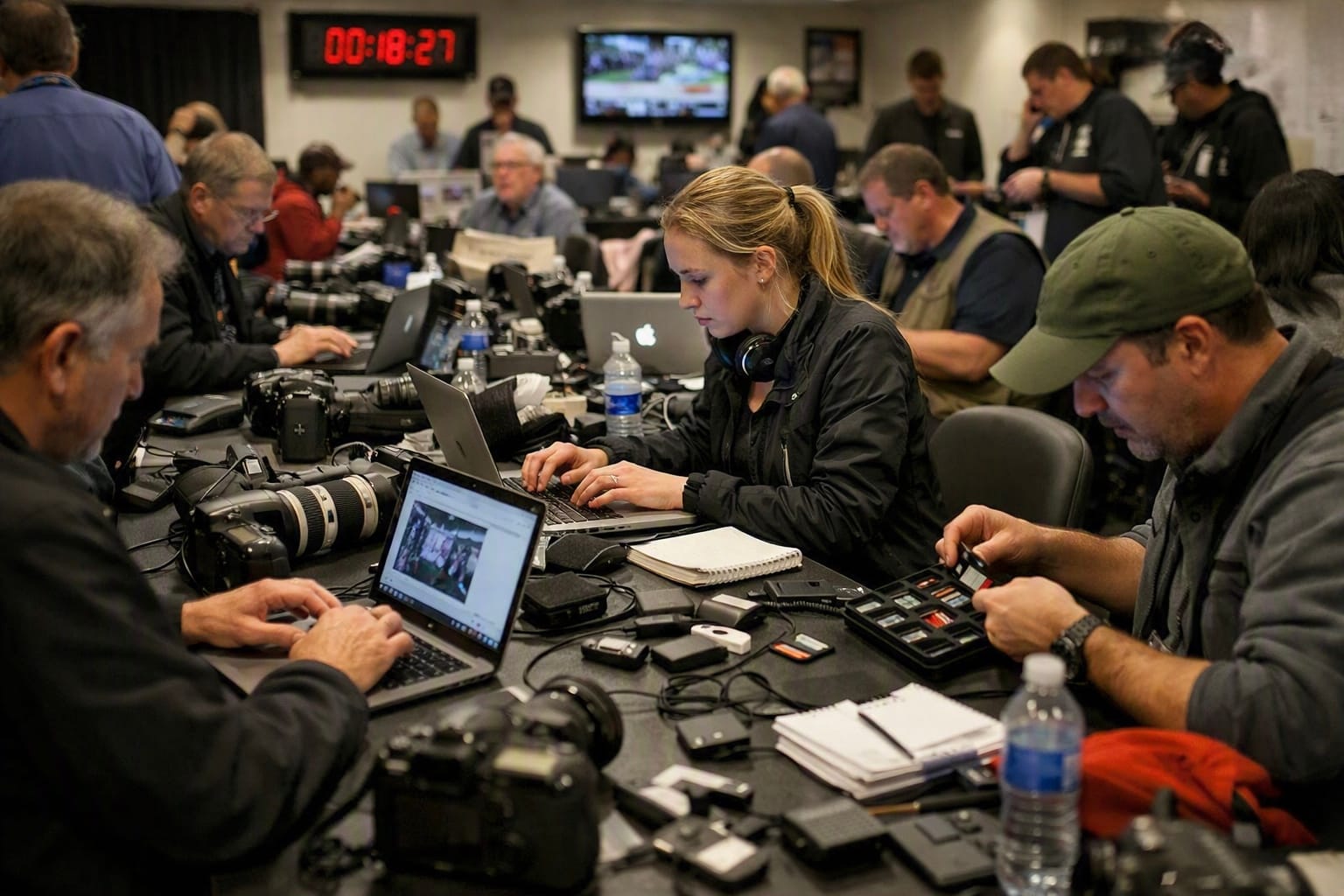
You need a digital delivery workflow, which is the chain of software and habits that gets an image from your memory card to an editor’s inbox or an agency’s upload system in a clean, correctly labeled, deadline-compliant state. For most working photographers this means a culling and captioning tool such as Photo Mechanic or Lightroom, a stable high-speed internet connection, and a defined export preset so you are not making sizing and format decisions under deadline pressure.
You need a one-page résumé and a portfolio link, not a physical printout. A password-protected online gallery, a PDF portfolio attachment, or a personal website with a clearly labeled editorial section all serve this purpose. The goal is the same as it was with a print book: an editor should be able to review your work in minutes without friction.
Finally, you need to understand two pieces of terminology that govern everything downstream. A cutline is the caption block that accompanies a news photograph, and it must answer who, what, when, and where in a concise factual sentence, formatted the way the specific outlet requires, often embedded directly in the image’s IPTC metadata rather than typed separately. Wire-service refers to organizations such as the Associated Press or Reuters that distribute images to many subscribing publications simultaneously, meaning a single submission can appear in dozens of outlets at once under a single licensing agreement.
Core Lesson & Step-by-Step Breakdown
Start with how you make contact. The old advice to skip email and call the photo editor directly assumed a newsroom culture where editors were reachable by phone and walk-in meetings were routine. That environment is largely gone. Most editorial desks and virtually every large agency now route freelance and stringer inquiries through email, online contact forms, or formal application portals, and a growing number of newsrooms explicitly discourage unsolicited calls during breaking news cycles because it pulls staff away from active coverage.
The modern equivalent of “cut through the noise” is a short, specific email addressed to the photo editor by name, not a generic submissions inbox, with a portfolio link in the body rather than large attachments. Subject lines should be direct: your name, your specialty, and the word “freelance” or “stringer inquiry.” A phone call still has value once you have an editor’s attention, particularly for time-sensitive breaking news submissions where speed matters more than formality, but it is no longer the default first move. Research who covers your regional beat, find their direct contact through the publication’s staff page or a professional network like LinkedIn, and lead with a concise, well-targeted email.
For agency work specifically, Getty Images and comparable outlets such as Icon Sportswire, Imagn, Zuma Press, and AP Images run structured contributor application processes through their own websites. These typically require a portfolio submission reviewed by an internal editorial team, proof of legal ability to shoot in your intended venues (meaning credentials or access, not just gear), and demonstrated understanding of usage rights and model or property release requirements. There is no walk-in equivalent. The entire process happens through the agency’s contributor portal, and approval can take weeks.
The Beginner’s Roadmap: Who, What, Where, and How
For a photographer with no existing editorial relationships, the process above can feel abstract. Breaking it into concrete steps removes the guesswork.
Who to contact. The title you are looking for is Photo Editor, Director of Photography, or, at smaller outlets, simply the person listed as managing the sports or news desk’s visual content. Do not contact the Editor-in-Chief or Managing Editor first; that person does not make freelance photography decisions and forwarding your inquiry costs you time. At a small regional paper, the same person may hold multiple titles, so check the masthead or staff directory page (usually linked in the site footer under “Staff,” “About,” or “Contact”) and look for anyone with “photo,” “visuals,” or “multimedia” in their title. If no dedicated photo editor is listed, the Sports Editor is the correct contact for sports-specific freelance inquiries. For regional sports organizations themselves (minor league baseball, indoor soccer, semi-pro and independent wrestling promotions), the correct contact is typically the team or promotion’s Media Relations Manager or Communications Director, not the front office generally. Their names and emails are usually listed on the organization’s official website under a “Media” or “Press” tab.
What to send. Your first outreach should contain exactly four elements: a one-line statement of who you are and what you shoot, a portfolio link (never large attachments in a cold email), one sentence establishing relevant access or specialty (for example, existing credentials, a regional beat you already cover, or specific teams and venues you can reliably reach), and a clear, low-friction ask. The ask should be small and specific: “I’d like to be considered for freelance sports coverage” reads as vague and gets ignored. “I shoot regional wrestling and minor league baseball across Maryland and can be on site for weekend cards with same-day turnaround” gives the editor something concrete to say yes to.
Where to find opportunities as a beginner. Do not start by targeting national outlets or major agencies. Start local and build outward. Community and regional newspapers, particularly ones that no longer employ a full-time staff photographer, are consistently the most accessible entry point because they need coverage and have limited internal capacity. Minor league and independent sports organizations (baseball, indoor soccer, independent wrestling promotions) frequently credential photographers in exchange for usage rights before any money changes hands, and that credentialed access itself becomes portfolio material. High school athletic departments and local athletic conferences often welcome photographers for game coverage with minimal formal process, which makes them a low-barrier way to build a body of work before approaching any paying outlet. Regional press associations and journalism organizations sometimes maintain freelancer directories that outlets check when they need last-minute coverage. Industry directories such as Pollstar Pro and Celebrity Access serve a related but distinct purpose for concert and touring credentialing, connecting photographers to tour publicists and venue marketing contacts rather than newsroom editors.
How to actually execute the outreach. Build the portfolio first. Before contacting anyone, have a minimum of fifteen to twenty strong, varied images live on a portfolio site, organized by category if you shoot multiple disciplines. Research the specific outlet or organization before writing anything. Read several of their recent published photos so your email can reference their actual visual standard rather than a generic pitch. Send the email on a weekday morning, avoiding game days or known deadline windows for that outlet, since editors are least reachable when they are on deadline. Follow up once, after roughly one week, with a short, polite note rather than a resend of the original email. If there is no response after a second attempt, move to the next contact rather than continuing to push the same one; editorial desks receive high volumes of freelance inquiries and a non-response is rarely personal.
Once initial contact succeeds, the realistic first outcome for a true beginner is not a paid assignment but a trial: an offer to cover a low-stakes event on spec, meaning the outlet reviews the resulting images before committing to any ongoing relationship or payment. Treat this trial exactly as you would treat paid work in every technical respect, because it is being evaluated as a preview of your reliability, not as a favor.
Portfolio, Conduct, and the Path Beyond First Contact
Once contact is made, your portfolio does the talking, and it needs to be as good as or better than what the publication or agency currently runs. Depth matters more than a handful of hero shots. An editor or a Getty reviewer needs to see that you can walk out the door tomorrow and fulfill an assignment competently, not just that you got lucky once with good light. For sports and event coverage specifically, that means demonstrating you can deliver key moments (scoring plays, decisive turns, emotional reactions) consistently across an entire event, not just a single standout frame.
Professional conduct still matters even though the venue for demonstrating it has moved online and into the field rather than a conference room meeting. Respond to editor communication promptly. If you are credentialed for an event, be on site early, know the venue’s photography positions and restrictions before you arrive, and be ready to discuss photography ethics if asked, particularly around image manipulation, staging, and conflict of interest. Editors and agency reviewers are not looking for a tentative freelancer who needs hand-holding on a deadline.
Once you are submitting work, the technical requirements are non-negotiable regardless of channel. For time-sensitive newspaper submissions, a quick email or a call to the news desk flagging that images are inbound is still standard practice, especially for breaking news. Every photo needs a proper cutline embedded in the file’s metadata: who, what, when, where. Timeliness is critical, generally within one to three hours for daily deadlines, though many outlets now expect same-cycle delivery within minutes for major sports or breaking events given the collapse of traditional print deadlines into rolling digital publication. Files typically go out as JPEG, sized to whatever web or print spec the outlet specifies, most commonly in the range of 2000 to 4000 pixels on the long edge at high quality compression. Editing stays minimal: basic tonal and color correction only, meaning exposure, white balance, and contrast adjustments, with no content-aware fill, no compositing, no generative tools, and no removal or addition of elements. This same discipline scales directly to Getty’s editorial contributor standard, which explicitly prohibits generative AI tools and permits only baseline correction. If you build that habit now as a stringer, you are already compliant later as a contributor.
Understand how breaking news changes the rights picture. If you happen upon news and submit unsolicited images, meaning you were not sent by an editor to cover the event, you typically retain your copyright and license the publication one-time usage rights for that specific run. If you are on assignment, meaning an editor directed you to cover a specific event, the outlet usually owns full rights under a work-for-hire or assignment contract, and you generally retain the ability to use those images for self-promotion but not for resale. Read any contract before you shoot, not after, so there is no confusion about what you can and cannot do with the images afterward. Most newspapers, agencies, and wire services including AP require this kind of contract for assignment work. Wire distribution rarely generates significant income for the photographer or the outlet on a per-image basis, so this is not a path to a windfall; the value is in volume and reputation, not any single sale.
Pay expectations should be realistic and vary by market size, region, and outlet type. Regional daily and wire assignment rates have historically clustered in the $150 to $300 range per assignment depending on market, though this varies significantly and should always be confirmed directly with the outlet before shooting, since published historical figures age quickly. Agency contributor work is typically structured differently, on a royalty or licensing split rather than a flat assignment fee, meaning your income depends on how often your images are licensed rather than a guaranteed per-shoot payment. Newspapers generally pay modest but consistent rates and do not typically stand up freelancers on payment. Do not expect early assignments to be glamorous. Small community events, youth and amateur sports, and low-profile local coverage are the standard entry point. What gets you called back is not the excitement of the assignment, it is whether you delivered clean, correctly captioned, on-time work every single time.
Real-World Demonstrations
Consider a photographer targeting a regional daily’s sports desk. Instead of showing up unannounced, they identify the sports photo editor by name through the paper’s staff directory, send a concise email with a portfolio link showing coverage of three different sports at the high school and semi-pro level, and mention specific regional teams they already have access to. The editor responds by email two days later with a trial assignment: cover a midweek soccer match and submit by 9 PM for next-morning print. The photographer shoots the match, culls to six usable frames within thirty minutes of the final whistle, embeds complete cutlines in the metadata using Photo Mechanic, and emails the files directly to the editor with the assignment reference in the subject line. The images run because the photographer respected the deadline and delivered files exactly to spec, with zero back-and-forth needed on formatting.
Now consider a true beginner with no clips at all. They spend three weekends shooting local high school football and a community 5K on their own initiative, building a fifteen-image portfolio hosted on a simple personal site. They identify the regional weekly paper’s staff contact, note that the paper’s existing football coverage relies on wire photos rather than original work, and send a short email offering to cover the next home game on spec. The editor agrees to review the results with no commitment attached. The photographer delivers correctly captioned, cleanly processed files within two hours of the final whistle. The paper runs two of the images the following week and offers a standing arrangement for the remainder of the season at a modest per-game rate.
Now consider the agency contributor path. A photographer with two years of credentialed regional wrestling and sports coverage applies to Getty’s editorial contributor program through the online portal, submitting a portfolio link and a summary of venues and events they can reliably access. The internal review team evaluates the portfolio against Getty’s existing editorial standard for that category, checks that the photographer’s example captions and metadata meet IPTC standards, and requests two additional samples showing environmental context rather than tight action crops only. After a revised submission, the photographer is approved as a contributor and receives access to Getty’s upload and licensing platform, where all future submissions are reviewed by an editorial team before going live for licensing.
Common Pitfalls & Troubleshooting
The most common mistake is treating a cold email like a formality and burying the actual ask in three paragraphs of biography. The fix is to lead with what you are asking for (freelance consideration for a specific beat or event type), keep the email under six sentences, and let the portfolio link carry the weight.
The second common mistake is contacting the wrong person, typically the Editor-in-Chief or a general newsroom inbox, and interpreting the resulting silence as rejection. The fix is confirming the correct title before sending anything, using the staff directory or masthead as the first stop, not the last.
The third common mistake is showing up to an application or a trial assignment with a thin portfolio padded by mediocre frames. Editors and agency reviewers notice filler immediately. The fix is ruthless self-editing before submission, not during review. Every frame should be defensible on its own merits.
The fourth mistake is over-processing submitted files, whether for a newspaper or an agency. Editorial reviewers are looking for accurate representation, not heavy stylization. If a photo editor or a Getty reviewer flags an image as overworked or rejects it for policy violation, the fix is to strip the edit back to basic exposure and white balance correction and resubmit clean.
The fifth mistake is missing or incomplete metadata. A technically strong image with no embedded cutline or incorrect IPTC fields will get rejected or delayed at both the newspaper and agency level, because captioning is not optional, it is a core deliverable.
The sixth mistake, more common now than in the print era, is misunderstanding which submission channel a given outlet actually uses. Sending a large batch of attachments to a general inbox when an outlet requires portal upload, or vice versa, signals that you have not done basic research on how that specific organization operates. Confirm the correct channel before you submit anything.
Best Practices & Pro Tips
Treat every early assignment, no matter how small, as a professional audition. The youth sports match and the small community event are not beneath the work, they are the proving ground that earns you the next call. Build your captioning and metadata workflow now so it is second nature under deadline pressure later, since this single habit separates photographers who get repeat work from those who do not. Keep your editing discipline consistent across every submission, whether it is going to a regional paper or eventually to an agency like Getty, because that consistency is what a reviewer or editor is actually evaluating over time. When starting from zero, build the portfolio through self-initiated coverage before you ever make first contact; showing up with existing, relevant work removes the biggest point of friction in any outreach. Reliability compounds. A photographer who delivers clean, correctly captioned, on-time work on ten small assignments will get the call for the eleventh, larger one before a more talented but inconsistent photographer ever does.
Closing Summary
Breaking into stringer work and editorial contributor status now runs almost entirely through digital channels: targeted email outreach to a named editor, portfolio links rather than physical prints, and formal application portals for agency contributor programs. For a true beginner, the sequence is specific: build a portfolio through self-initiated local coverage, identify the correct contact by title (a photo editor, sports editor, or media relations manager, never the top newsroom masthead name), find opportunities at the local and regional level before targeting national outlets or agencies, and execute outreach with a short, researched, low-friction email. What has not changed is the underlying standard: a portfolio matching or exceeding the outlet’s existing quality bar, disciplined technical delivery including complete embedded cutlines and minimal processing, a clear understanding of how rights transfer on assignment versus unsolicited work, and realistic pay expectations that favor consistency over big paydays. The photographers who succeed are not necessarily the most talented in the room. They are the ones who research the correct channel, communicate clearly, and deliver exactly what was asked for, every time, without exception.