
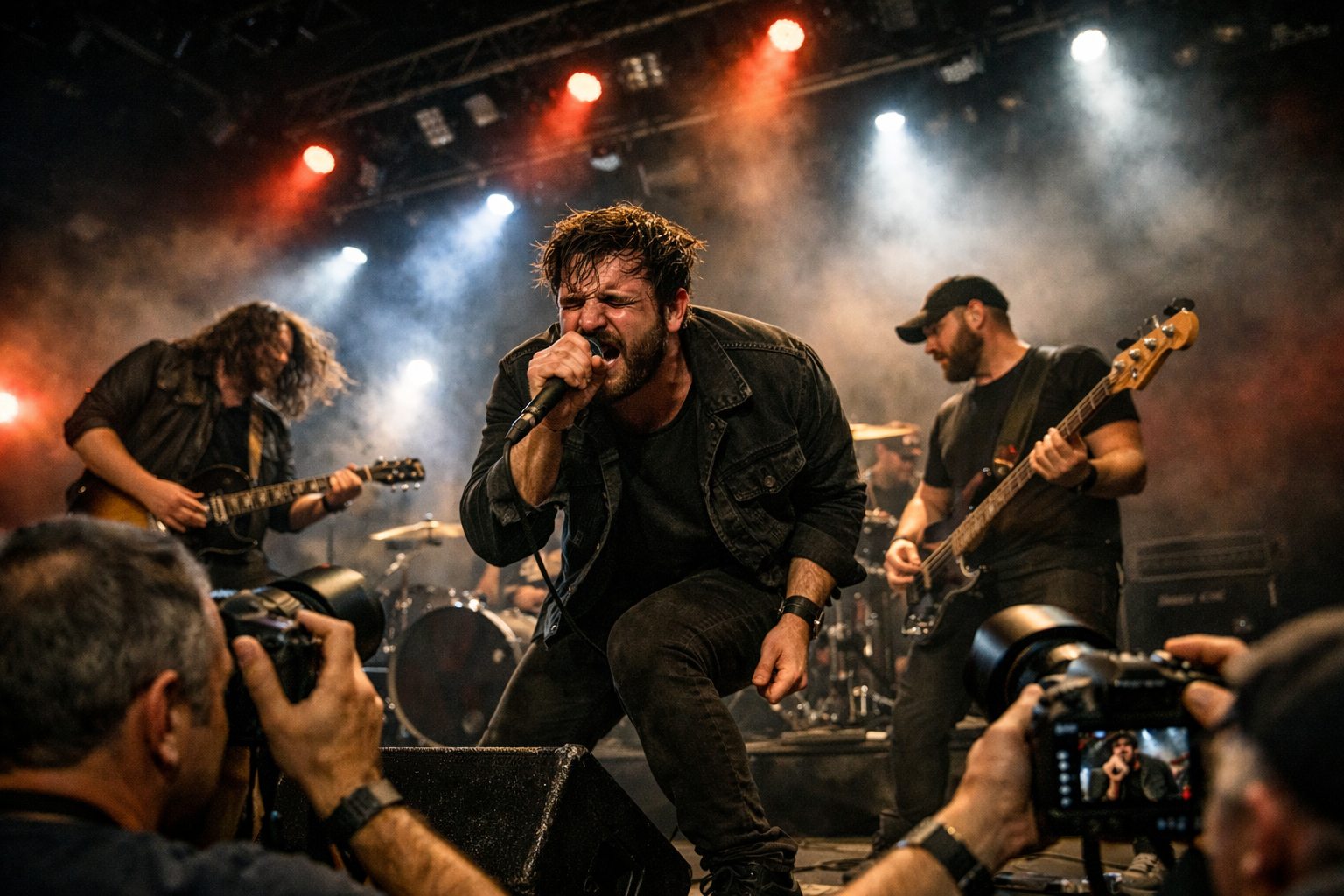
Concert photography operates under constraints unlike any other assignment category. Low light, rapid subject movement, unpredictable stage lighting, and strict access limitations combine to create one of the more demanding shooting environments in editorial work. Success depends less on gear and more on preparation, positioning, and adherence to venue and artist protocols.
The Three Song Rule
Most professional concert photography credentials operate under what is commonly called the three song rule. Photographers with pit access are permitted to shoot for the first three songs of a set, typically from the photo pit between the barricade and the stage, after which they must exit and surrender further stage-adjacent access for the remainder of the performance.
This rule exists for several practical reasons:
- It limits the number of photographers occupying pit space during a full set, reducing disruption to the audience and performer sightlines.
- It protects the artist's control over their visual presentation, particularly during later portions of a set when lighting, choreography, or costume changes may not be intended for wide distribution.
- It standardizes access across outlets, preventing any single photographer from monopolizing pit time.
The rule is not universal. Some tours, festivals, and independent venues set different terms, ranging from one song to full-set access, depending on artist management, publicist agreements, and venue policy. Photographers should confirm terms in writing before the event rather than assuming the three song standard applies by default.
Pit Etiquette
Photo pit conduct is governed by unwritten but consistently enforced norms:
- Stay within the pit boundary. Do not climb the barricade or shoot from within the crowd unless explicitly permitted.
- Avoid blocking other photographers' sightlines. Pit space is shared, and positioning should account for the photographers on either side.
- Do not use flash unless specifically authorized. Most venues and artists prohibit it outright, both for audience comfort and because flash rarely improves results under stage lighting.
- Exit promptly when the allotted time expires. Security and stage management track this closely, and repeated violations affect future credential access, both for the individual photographer and the outlet they represent.
- Minimize movement during quieter musical passages. Acoustic sets or ballads warrant more restrained positioning than high-energy numbers.
Technical Considerations
Concert lighting is inconsistent by design. Exposure settings must be adjusted continuously rather than locked in.
- Aperture: Wide apertures such as f1.8 or f2.8 are standard to maximize light gathering and isolate the subject against a dark or complex background.
- Shutter speed: A minimum of 1/250 is recommended to freeze performer movement; faster subjects, particularly during high-energy sets, may require 1/500 or higher.
- ISO: Concert venues frequently demand ISO 3200 to 6400 or higher, depending on stage lighting intensity. Modern full-frame sensors handle this range with acceptable noise levels, but photographers should evaluate their specific camera's high-ISO performance beforehand rather than during the assignment.
- Metering: Spot or center-weighted metering performs better than matrix metering in concert environments, since stage lighting often creates strong contrast between the performer and background.
- Focus mode: Continuous autofocus with a narrow focus area helps track performer movement without hunting across a dark, high-contrast frame.
White balance shifts constantly under colored stage lighting. Shooting in RAW is not optional in this context; it allows correction in post without introducing artifacts that JPEG compression would lock in.
Access and Credentialing
Photographers should treat credential terms as binding documentation, not informal guidance. This includes:
- Written confirmation of pit access duration
- Any restrictions on lens focal length (some pits limit lenses to a certain length to prevent obstruction)
- Publicist requirements for image review or approval before publication
- Any embargo on publication timing
Failure to follow credential terms can result in loss of future access, not only for the individual photographer but for the outlet they represent. This is a professional liability issue, not a matter of preference.
Post-Event Workflow
Standard workflow applies: import, cull, edit, and deliver. Given the volume of frames typically captured during a three-song window, culling should prioritize technical sharpness first, then expression and stage composition. Editorial delivery timelines for concert coverage are typically compressed, often same-day or next-day, given the news-cycle relevance of live event coverage.