
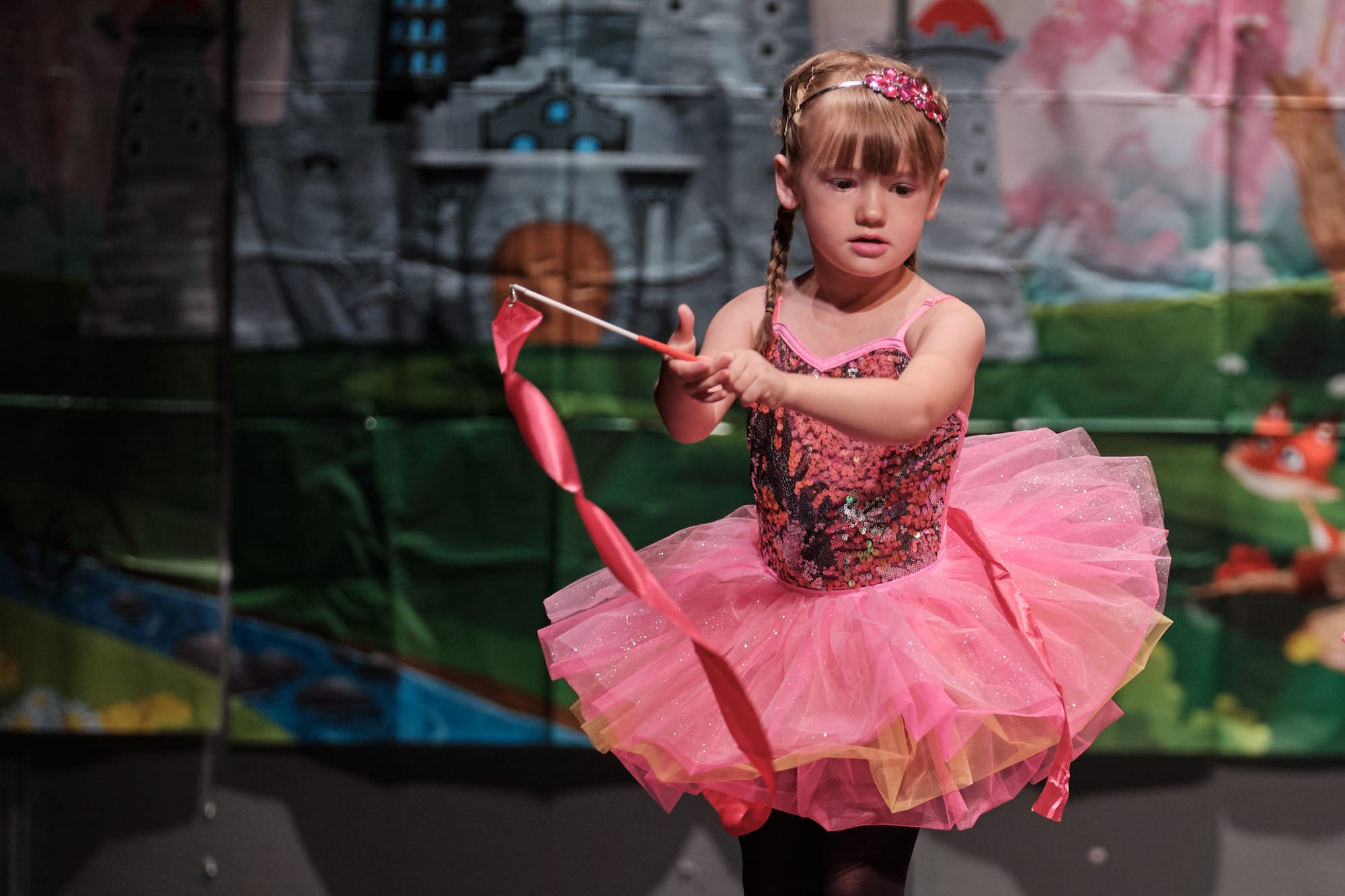
Let’s explore the unique challenges photographers face when shooting dance recitals in school and college auditoriums and provide practical recommendations for achieving clear and properly exposed images.
Stage Lighting Problems
Auditorium lighting is designed for the audience rather than cameras. This often results in color spikes from LED fixtures, rapid flicker that causes banding, hot spots that blow out highlights, and deep shadows that hide detail.
How to Overcome It
- Use manual exposure to prevent the camera from reacting unpredictably to sudden lighting changes.
- Set shutter speed above 1/500 to freeze motion and adjust ISO accordingly.
- Enable high frequency flicker reduction if your camera supports it. Additionally, take it even further by dialing in a specific incremental shutter speed if your camera supports it.
- Shoot RAW to allow for color correction and highlight recovery.
Fast Unpredictable Motion
Dancers move quickly and change direction without warning. Auditorium lighting rarely supports slow shutter speeds, so technique becomes essential.
How to Overcome It
- Use continuous autofocus with subject tracking to maintain focus on performers.
- Choose shutter speeds between 1/800 and 1/1000 for jumps and spins.
- Shoot short bursts to capture peak action.
- Watch earlier groups or rehearsals to anticipate choreography.
Exposure Swings
Lighting can shift from dim blue to bright white in an instant, causing major exposure fluctuations.
How to Overcome It
- Expose for the brightest moment rather than the average.
- Use highlight weighted metering if available.
- Check the RGB histogram to avoid clipping individual channels.
- Apply exposure compensation only when forced into semi auto modes.
Restricted Movement
Many auditoriums limit where photographers can stand. You may be confined to aisles, the back of the room, or side positions.
How to Overcome It
- Use a telephoto zoom such as a 70 to 200 or 100 to 400 to reach the stage.
- Shoot from a seated or kneeling position to avoid blocking the audience.
- Stabilize the camera using your knee or a seat back when tripods are not allowed.
- Arrive early to secure the best permitted angle.
- Arrange for prime seating ahead of time with the dance studio.
Color Noise and Underexposure
High ISO values often introduce chroma noise, especially under blue or purple lighting.
How to Overcome It
- Expose slightly to the right without clipping highlights.
- Apply color noise reduction generously during editing.
- Avoid underexposing since lifting shadows increases noise.
- Use fast lenses to keep ISO manageable.
Busy Backgrounds
Curtains, props, and stage decorations can distract from the dancers.
How to Overcome It
- Shoot at f2.8 to f4 to soften the background.
- Use longer focal lengths to isolate subjects.
- Time shots when dancers move away from cluttered areas.
Summary
Dance recitals combine unpredictable lighting, fast motion, and limited shooting positions. By using manual exposure, fast shutter speeds, continuous autofocus, RAW capture, telephoto reach, and careful noise management, photographers can consistently produce clear and properly exposed images in challenging auditorium environments.